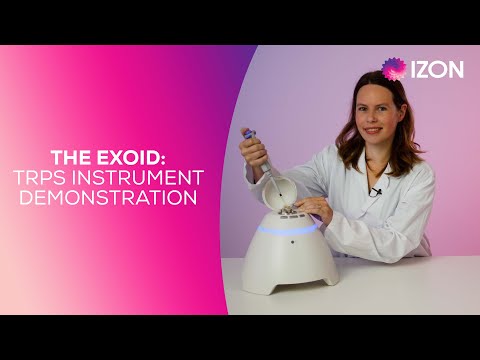
Measure Particle Size, Concentration & Zeta Potential with Unparalleled Precision
Tunable Resistive Pulse Sensing (TRPS) is a single-particle measurement technique for nanoparticles ranging from 40 nm to 11 µm. TRPS measures individual particle size, concentration, and zeta potential with precision and accuracy beyond that of commonly used light scattering techniques, which provide bulk estimates. TRPS is suitable for various biological samples, including exosomes/extracellular vesicles, virus-like particles, lipid nanoparticles, and other biopharmaceuticals.
Characterise With Precision and Accuracy
Measure individual exosomes, extracellullar vesicles and nanoparticles from 40 nm to 11 µm.
Simultaneously Measure Particle Size and Concentration
Obtain number-based size distribution plots, derived on a real particle-by-particle basis.
Measure the Zeta Potential of Individual Particles
Precisely measure the zeta potential and size of each particle in your sample.
Measure Individual Particles With Confidence
The precision, resolution and accuracy of size measurement in Tunable Resistive Pulse Sensing (TRPS) is unmatched by any other nanoparticle analysis technique. TRPS measures nanoparticles suspended in electrolytes on a particle-by-particle basis as they pass through a tunable nanopore. When particles pass through they momentarily disrupt the electrical current in the pore, which creates a blockade. The dimensions and frequency of these blockades are used to determine particle size, concentration and zeta potential. Every particle measured is compared to a set of NIST-traceable calibration particles of known size, which ensures accuracy and repeatability.
Why Use Tunable Resistive Pulse Sensing?
01
Tunable Resistive Pulse Sensing (TRPS) is a true single-particle measurement technique that provides far greater resolution over ensemble techniques.
02
Reproducibility is enabled through the use of standardised NIST-traceable calibration particles.
03
Automated data processing is achieved via a user-friendly data visualisation interface.
04
Unlike other techniques, TRPS measurements do not rely on prior knowledge of the optical properties of particles or the dispersant.
05
Parameters are adjusted to maximise the signal-to-noise ratio and are monitored during calibration and sample measurement to ensure high-quality data.
Simultaneously Measure Size and Concentration
Using Tunable Resistive Pulse Sensing (TRPS), you can simultaneously measure particle size and concentration. As particles individually pass through a nanopore, a blockade is created. The magnitude of the blockade is directly proportional to particle size while the frequency of the blockades is used to determine concentration. TRPS can distinguish multiple subpopulations with high resolution, which is an important capability for fields working with polydisperse samples, such as extracellular vesicle (EV) research.
Tunable Resistive Pulse Sensing: Bringing Resolution to Particle Characterisation
TRPS is used in a wide range of applications including exosomes/extracellular vesicles, viruses and virus-like-particles, nanomedicine and other heterogenous nanoparticles. Select your field to read relevant publications and case studies.